
Fabric weight (GSM) for suiting: a buyer's guide
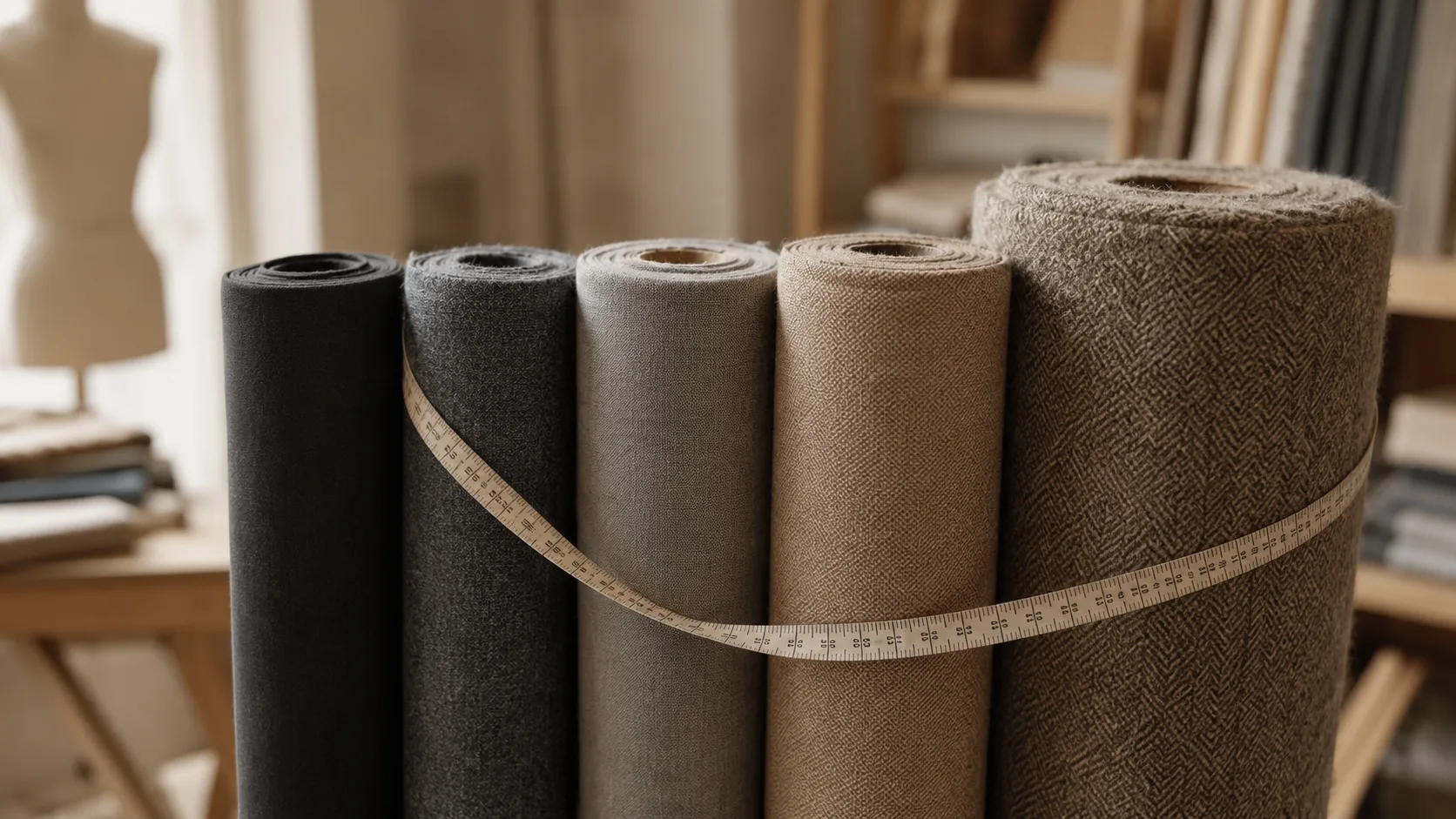
Weight is the first number on almost every fabric specification, and the one buyers argue about most. Get it right and a garment hangs, presses, and wears the way it should. Get it wrong and no amount of good tailoring will save it. Here is how to think about GSM when you order suiting fabric.
What GSM actually measures
GSM is simply grams per square metre: take one square metre of the fabric, weigh it, and that's the number. Because it's normalised to area, it lets you compare two fabrics fairly regardless of roll length or width. A 240 g/m² cloth at 150 cm wide and a 240 g/m² cloth at 145 cm wide weigh the same per square metre, even though a linear metre of the wider one weighs more.
You'll also see older units. The tailoring trade often quotes wool suiting in ounces per yard (oz), and some mills use grams per linear metre. A rough rule for converting ounces to GSM is to multiply by about 33–34 (it depends on width), so a classic "9 oz" suiting lands around 290–310 g/m². When in doubt, ask for GSM; it's the least ambiguous.
The practical weight ranges for suiting
There is no single "correct" suiting weight; the right answer depends on the garment and the climate it's worn in. As a working guide for woven suiting:
| Weight (g/m²) | Character | Typical use |
|---|---|---|
| 150–190 | Lightweight, breathable, more drape | Summer suits, hot climates, unstructured jackets |
| 190–230 | Light all-rounder | Trans-seasonal suiting, warm regions |
| 230–260 | Mid-weight, the everyday workhorse | Year-round business suits, uniforms, trousers and jackets |
| 260–300 | Substantial, holds structure and a press | Cooler climates, structured tailoring, hard-wearing workwear |
| 300+ | Heavy, warm, very durable | Winter suiting, overcoating, heavy-duty uniforms |
Most of the poly-rayon suiting we trade sits in the 230–260 g/m² band, which is the sweet spot for year-round business wear sold into China, Europe, Central Asia, and the Middle East: enough body to tailor cleanly and hold a crease, not so heavy that it's uncomfortable indoors. Worsted wool suiting is often specified a touch heavier for the same structured feel.
Why weight alone never tells the whole story
The biggest mistake is treating GSM as a quality score, as though heavier automatically meant better. It doesn't. Weight tells you how much fibre is in a square metre; it says nothing about how good that fibre or fabric is. Two fabrics at an identical 250 g/m² can perform completely differently because of:
- Fibre and yarn. A fine, high-twist yarn produces a crisper, more refined cloth than a coarse one at the same weight. (See how suiting fabric is made.)
- Weave and construction. A dense twill and an open plain weave at the same GSM behave nothing alike in drape and durability.
- Finishing. Pressing, heat-setting, and surface treatments change hand and recovery without changing weight.
- Composition. A poly-rayon blend and a wool cloth at the same GSM differ in warmth, breathability, and crease recovery.
Weight tells you how much cloth there is; yarn, weave, and finishing tell you how good it is. Order against all four, not just the first.
How to specify weight on an order, and a note on tolerance
When you send a specification, give the target GSM together with the composition, width, and end use. That context lets the mill (or us) match a real article rather than guess. A few practical points:
- Tolerance is normal. Woven fabric is rarely exact to the gram. A tolerance of roughly ±5% on weight is standard; agree it up front so a 245 g/m² delivery against a 250 g/m² order isn't a surprise.
- Finished vs greige weight. Always specify the finished weight. Fabric changes weight through dyeing and finishing, so a greige figure can mislead.
- Pair weight with width. At 150 cm versus 145 cm, the same GSM yields a different number of garments per metre, which matters to your costing.
On every lot we ship, weight is one of the numbers we verify at the mill, alongside width, colour fastness, and weaving defects, precisely because it's the spec buyers feel first and complain about loudest.
Key takeaways
- GSM is grams per square metre, the clearest way to compare how substantial two fabrics are.
- For year-round suiting, 230–260 g/m² is a practical all-purpose range; go lighter for heat, heavier for winter and structure.
- Higher GSM does not mean higher quality; yarn, weave, finishing, and composition matter just as much.
- Specify finished weight with a ±5% tolerance, and pair it with width and end use.
Know the weight you need? Browse the catalog (every article lists composition, weight, and width) or send your specification and we'll quote within one business day.