
Inside the mill: how suiting fabric is made in Keqiao
Most buyers see fabric only at the two ends of its life: a swatch on the desk and a roll on the cutting table. Between those two moments sit a dozen separate operations, often in different factories, each one capable of making or ruining the cloth. This is what actually happens to suiting fabric in Keqiao, Shaoxing, the largest textile cluster in the world, and it is where, in our experience, quality is won or lost.
Keqiao is a cluster, not a single factory
The first thing to understand is that "the mill" is rarely one building. Keqiao District, in Shaoxing, is home to the China Textile City and tens of thousands of specialised workshops. Yarn comes from one supplier, warping and weaving happen at a weaving mill, dyeing and finishing at a separate dye house, and inspection and packing somewhere else again. A single roll of suiting fabric can pass through four or five companies before it ships.
This specialisation is exactly why Keqiao can produce so much fabric so cheaply, but it also means quality depends on coordination between firms that don't answer to one another. Closing that gap is the work a sourcing partner does on the ground.
1. Yarn: where the hand of the fabric begins
Everything downstream is constrained by the yarn. For the poly-rayon suiting we trade most, that means a blended spun yarn, typically around 65% polyester and 35% rayon (viscose), engineered to behave like a wool-blend worsted at a fraction of the price. The polyester carries strength, crease recovery, and dimensional stability; the rayon brings softness, drape, and a matte, wool-like surface instead of a plastic sheen.
Two yarn details decide more than buyers expect:
- Yarn count, or how fine the yarn is. Finer yarn makes a smoother, lighter, more refined cloth; coarser yarn makes a fuller, cheaper, heavier one.
- Twist, or how tightly the fibres are spun together. Higher twist gives a crisper, more durable, more crease-resistant fabric with a drier handle; low twist feels softer but pills and creases more easily.
Worsted wool suiting follows the same logic with combed wool tops rather than blended staple, which is why a 100% wool cloth at the same weight costs several times more.
2. Warping and beaming: setting up the loom
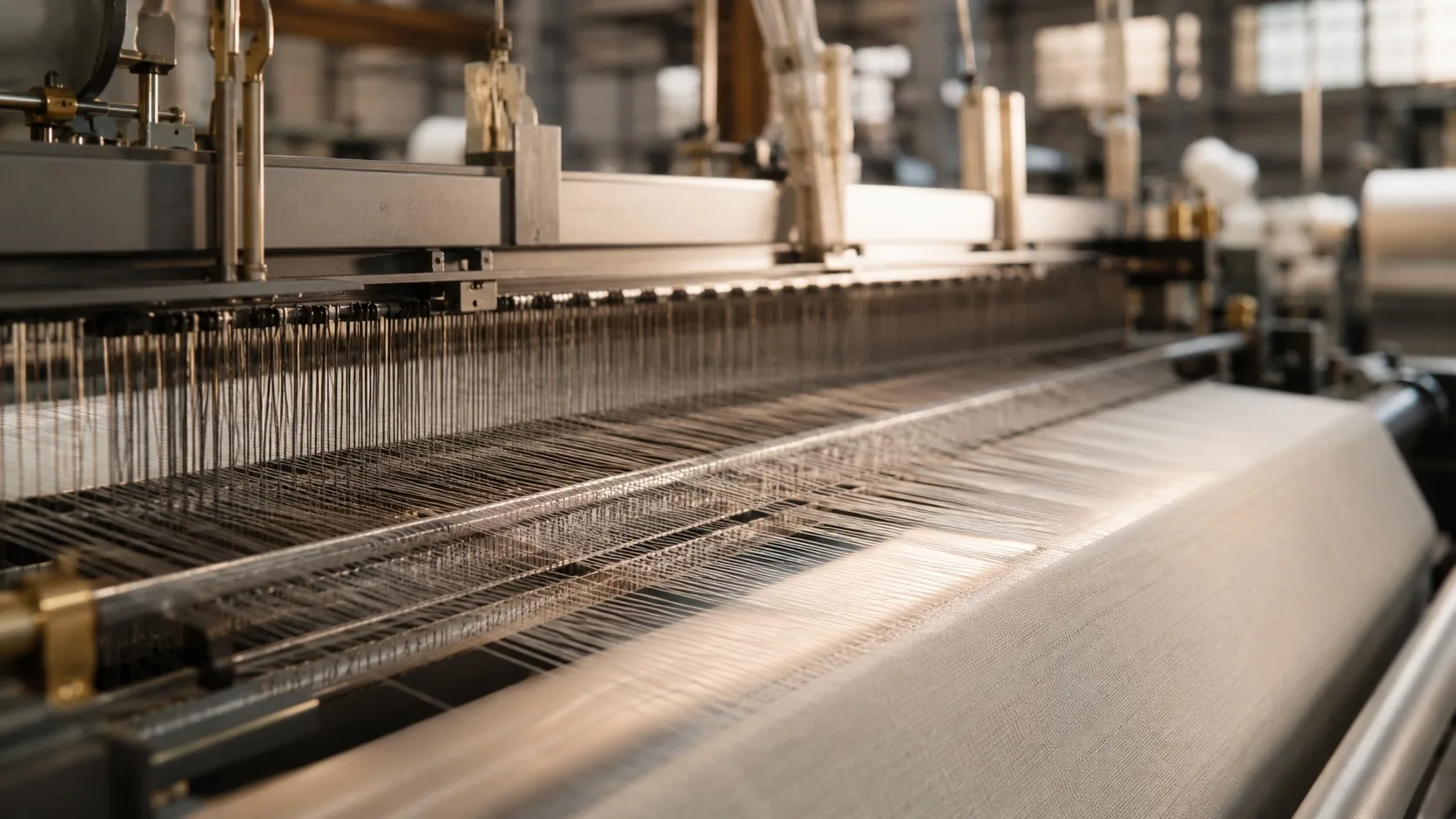
Woven fabric is two sets of threads at right angles: the warp runs the length of the roll, the weft crosses it. Before weaving can start, thousands of warp ends (often 4,000 to 8,000 across a suiting width) are wound in parallel onto a beam under even tension. This is warping, and it stays invisible in the finished cloth until it goes wrong: uneven tension here shows up later as streaks, tight selvedges, or fabric that won't lie flat.
For patterned fabrics (pinstripes, multi-stripes, checks), the colour is already in the yarn before weaving, and the coloured warp threads are arranged in the exact stripe sequence on the beam. The pattern is literally built into the warp. The colour can reach the yarn at different stages: in our poly-rayon blends it is added to the fibre before the fibre is even formed (dope-dyed), in our worsted wool the combed fibre is dyed before spinning (top-dyed), and at many other mills spun yarn is dyed on cones (yarn-dyed). Our guide to dope-dyed, top-dyed, yarn-dyed and piece-dyed fabric explains the difference. A woven-in pattern is more work than printing or piece-dyeing, and one reason patterned suiting reads as more "tailored".
3. Weaving: the structure that becomes the cloth
On the loom, the weft is inserted across the warp shed thread by thread. Modern Keqiao weaving mills run air-jet, water-jet, or rapier looms at high speed. The weave, meaning the over-under pattern, defines the fabric's character:
- Plain weave: the simplest interlacing; flat, firm, hard-wearing.
- Twill: the diagonal rib you see in gabardine and most trouser suiting; drapes well, hides soil, resists creasing.
- Satin and dobby/jacquard: longer floats or figured patterns for a smoother face or a woven motif.
This is the stage most likely to leave visible defects: broken ends, floats, slubs, missing picks, and oil stains from the machinery. A good mill stops and repairs; a rushed one weaves through. Greige (loom-state) fabric is then checked on a backlit frame before it leaves for the dye house.
4. Dyeing and finishing: the make-or-break stage
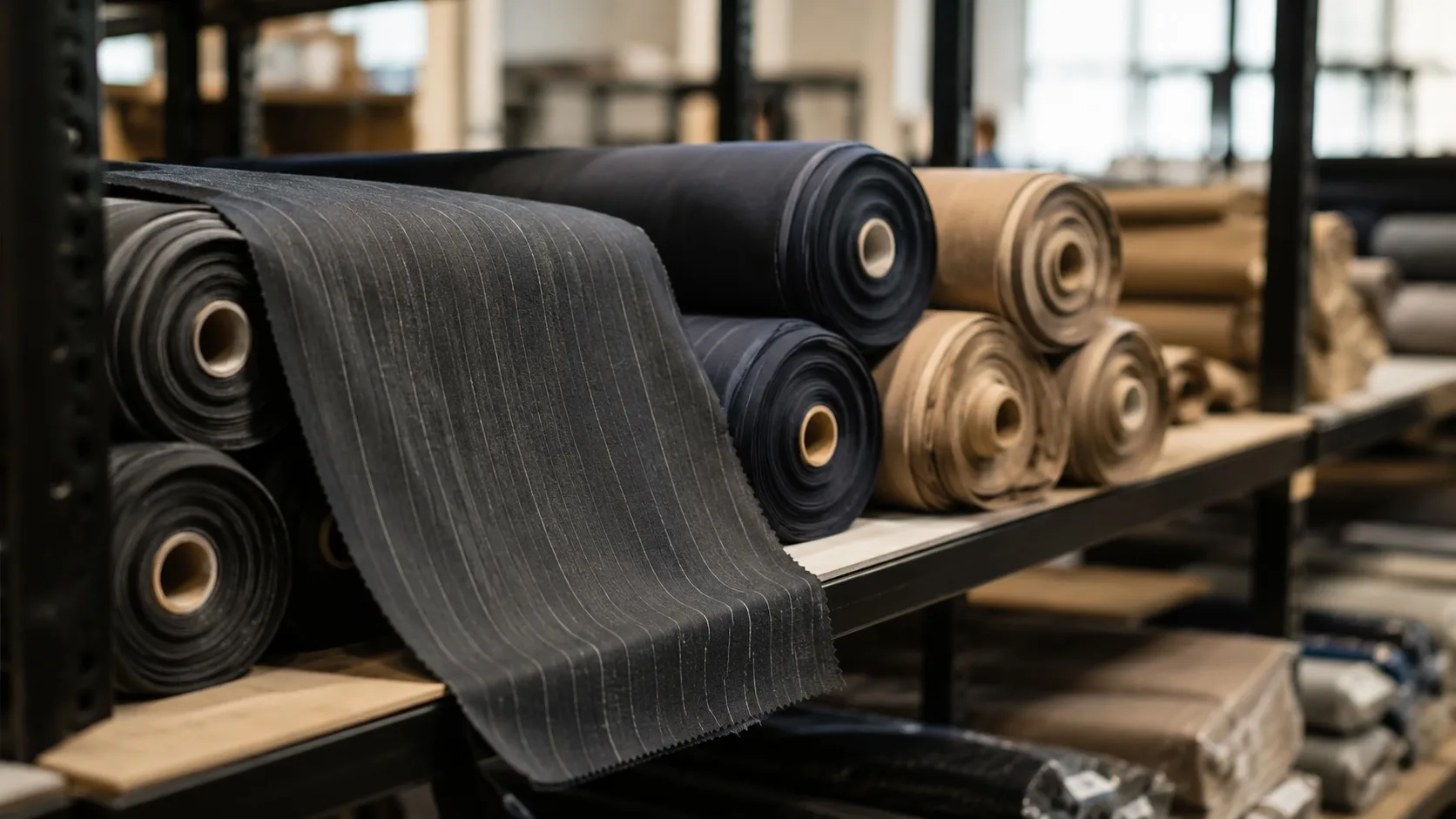
For piece-dyed fabric (solid colours in twill or gabardine), the woven greige cloth is dyed as a whole piece. Polyester and rayon take dye differently, so a poly-rayon blend is usually dyed in two steps, disperse dye for the polyester and then a separate class for the rayon, to reach an even, solid shade. Get the chemistry or temperature wrong and you see cross-dyeing, shade variation between rolls, or poor fastness.
Finishing is what turns dyed cloth into suiting. Depending on the quality it may include:
- Heat-setting to lock in dimensional stability so the fabric doesn't shrink or skew.
- Calendering or pressing for surface smoothness and a subtle lustre.
- Brushing or sueding for a softer, peached hand.
- Functional finishes such as anti-static, water-repellent, or wrinkle-resistant treatments, applied as needed.
Two fabrics with an identical composition and weight can feel completely different because of finishing. It is also where corners get cut invisibly, which is why we judge a mill on its finished goods, not its spec sheet.
5. Inspection, weight, and width: the numbers buyers order against
Before packing, fabric is inspected on a light frame and measured. Three numbers matter on every order:
- Weight (GSM): grams per square metre, the single best proxy for how substantial the cloth is. Most poly-rayon suiting sits around 230–260 g/m². (See our guide to fabric weight.)
- Width: usually 150 cm for suiting, which sets how many garments you cut per metre.
- Fastness: how well the colour resists rubbing, light, and washing, graded on standard scales.
A common four-point inspection system assigns penalty points per defect; lots over an agreed threshold are rejected or re-graded. This is the step that separates first-quality export goods from stock-lot fabric, and the step most often skipped when a buyer is not represented at the source.
Where quality is actually decided
Notice that no single stage "makes" the fabric. The cloth inherits its hand from the yarn, its pattern from the warp, its structure from the loom, its colour and feel from finishing, and its grade from inspection. A weakness at any one of them carries through to the cutting table.
A spec sheet only describes the fabric a mill means to make. Inspection tells you what it actually made, and most of our work lives in the gap between the two.
That is why we buy direct from mills around Keqiao rather than through layers of agents, and why we check weight, width, colour fastness, and weaving defects on every lot before it ships. Working at the source is the only reliable way to know that the roll on your cutting table matches the swatch on your desk.
Key takeaways
- Suiting fabric passes through several specialised firms in Keqiao (yarn, weaving, dyeing and finishing, inspection), not a single factory.
- Yarn count and twist set the hand; the warp setup carries the pattern; finishing decides how the cloth feels.
- Patterned fabric is coloured before weaving, as dope-dyed or top-dyed fibre or as yarn-dyed yarn (higher value); piece-dyed is dyed as woven cloth.
- Weight (GSM), width, and colour fastness are the numbers you order against, and lot inspection is where quality is confirmed.
Looking at a specific quality? Browse the fabric catalog or send us a specification and we'll reply within one business day.