
Oeko-Tex Standard 100, explained for fabric buyers
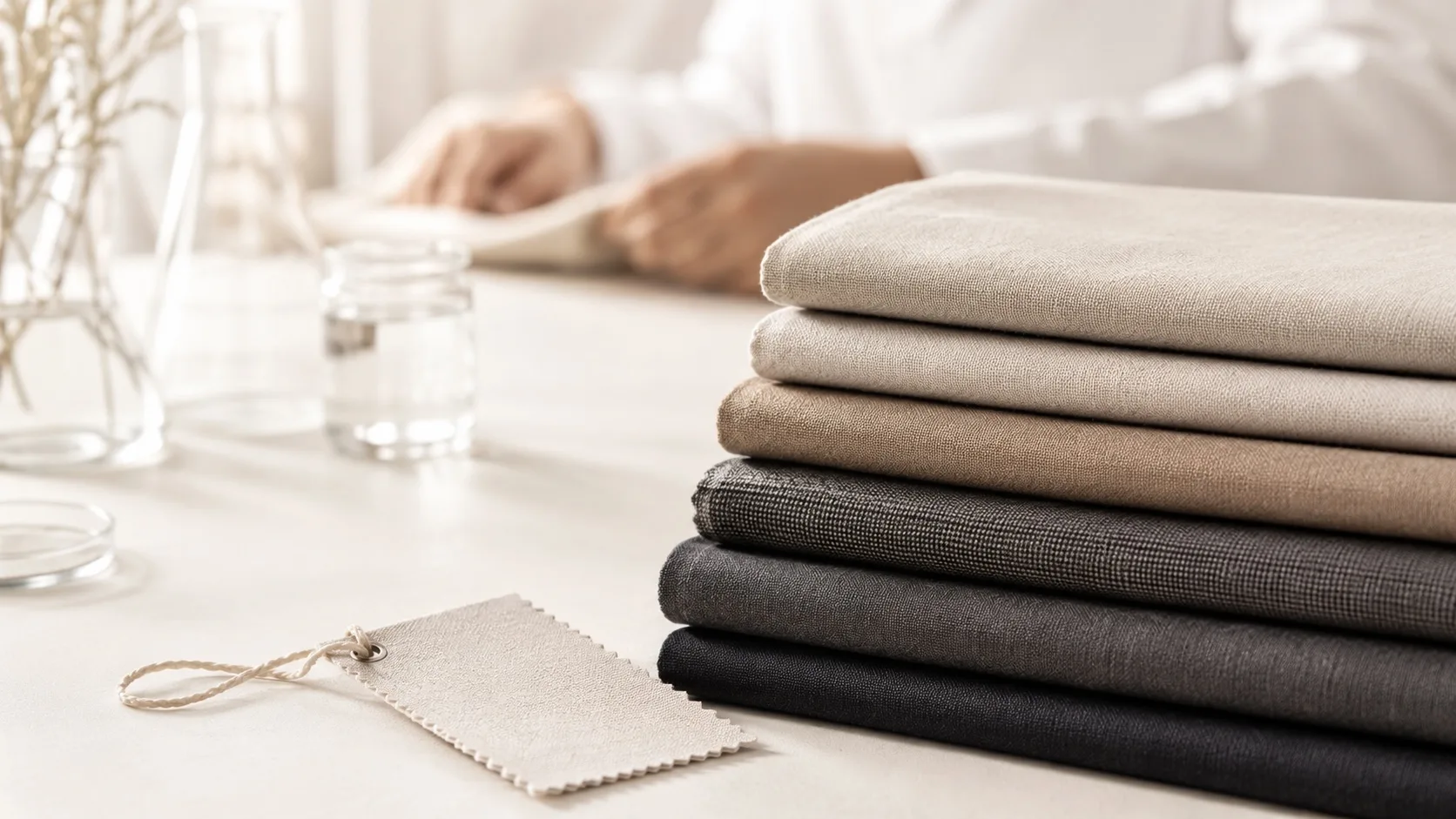
"Is it Oeko-Tex certified?" is one of the first questions a serious garment buyer asks, and one of the most misunderstood. Here is what the certification actually means, what it does and doesn't cover, and how to read a certificate so the answer means something.
What Oeko-Tex Standard 100 actually is
Standard 100 by Oeko-Tex is an independent testing and certification system for textiles, run by the International Oeko-Tex Association. When an article carries the label, it means every component of that article (the fabric itself, but also sewing thread, linings, prints, coatings, buttons, and other accessories) has been laboratory-tested for harmful substances and found to be within strict, published limit values.
The key idea is in that last sentence: every component. A certificate isn't a vague badge of "eco-friendliness". It is a statement that the finished textile is safe for human contact, tested against a defined list of regulated and health-relevant chemicals.
What it tests for
The criteria catalogue runs to hundreds of individual substances and is updated every year as regulation and science move. In practice it covers, among others:
- Regulated azo dyes that can release carcinogenic amines, plus other restricted colourants.
- Formaldehyde and other finishing-chemical residues.
- Extractable heavy metals such as lead, cadmium, and nickel.
- Pesticides, chlorinated phenols, and plasticisers (phthalates).
- PFAS and other substances of concern, plus a check on skin-friendly pH and colour fastness as a health-relevant property.
Testing is carried out by accredited Oeko-Tex institutes, not by the manufacturer, and certification requires the company to operate a quality-assurance system and submit to audits. Certificates are valid for twelve months and must be re-tested and renewed to stay current.
The four product classes
Not all textiles touch the skin equally, so the limit values get stricter the closer the product sits to the body. Every certificate states one of four product classes:
| Class | Applies to | Strictness |
|---|---|---|
| I | Articles for babies and toddlers (up to 3 years) | Strictest |
| II | Articles worn next to the skin (shirts, underwear, bedding) | Very strict |
| III | Articles worn away from the skin (jackets, outerwear) | Strict |
| IV | Furnishing and decoration materials (curtains, upholstery) | Standard |
For suiting fabric, the relevant question is how the finished garment is worn. A suit jacket is typically Product Class III; trousers and anything that sits against the skin push toward Class II. A higher class on the certificate is more demanding, so it's worth matching the class to your end use rather than assuming "certified" means one fixed thing.
What it does not mean
This is where buyers most often get it wrong. Standard 100 is a product-safety certification: it tells you the finished textile is free of harmful substances above the limits. It is not:
- An organic or natural-fibre label. A 100% polyester fabric can be, and frequently is, Standard 100 certified. The certificate says nothing about fibre origin.
- An environmental footprint. Water use, energy, emissions, and chemical management at the factory are covered by other Oeko-Tex schemes such as STeP, or by standards like GOTS for organic content.
- A guarantee of labour or social conditions. That is the domain of social-compliance audits, not Standard 100.
If a supplier offers an Oeko-Tex Standard 100 certificate as proof of "sustainability", they are either confused or hoping you are. It is an important and worthwhile certificate, for exactly what it covers and nothing beyond that.
How to read and verify a certificate
A genuine certificate is easy to check, and you should always check it rather than trust a logo on a hangtag:
- Every certificate has a unique number and names the issuing institute and the certificate holder.
- It lists the specific certified articles: make sure the fabric you are buying is actually named, not a different article from the same mill.
- It states the product class and a validity date.
- Confirm all of this in the official Oeko-Tex Label Check (or by scanning the QR code on a valid label), which shows whether the certificate is live and what it covers.
A photo of a certificate proves nothing on its own. What counts is the certificate number, checked against the official database.
Where Nemerc fits
We can source and supply Oeko-Tex Standard 100 certified suiting fabric on request, working with mills around Keqiao that hold current certificates for the relevant articles. Because certification applies to specific articles and expires annually, the practical work is making sure the certificate on file matches the fabric you are actually ordering and is still valid at the time of shipment. That is exactly the kind of source-side checking we already do on weight, width, and colour fastness for every lot.
If certification is a requirement for your market, tell us at the inquiry stage so we can quote certified qualities from the start.
Key takeaways
- Standard 100 certifies that every component of a textile is tested and safe from harmful substances; it is a product-safety label.
- The four product classes get stricter the closer the article sits to the skin; match the class to your end use.
- It is not an organic, environmental, or social-compliance certificate; different standards cover those.
- Always verify the certificate number, holder, certified articles, and validity in the official Oeko-Tex Label Check.
Need certified fabric for your market? Tell us at the inquiry stage and we'll quote Oeko-Tex Standard 100 qualities from the start. New here? Start with how suiting fabric is made.