
Quality control before a fabric ships: what we check, and why
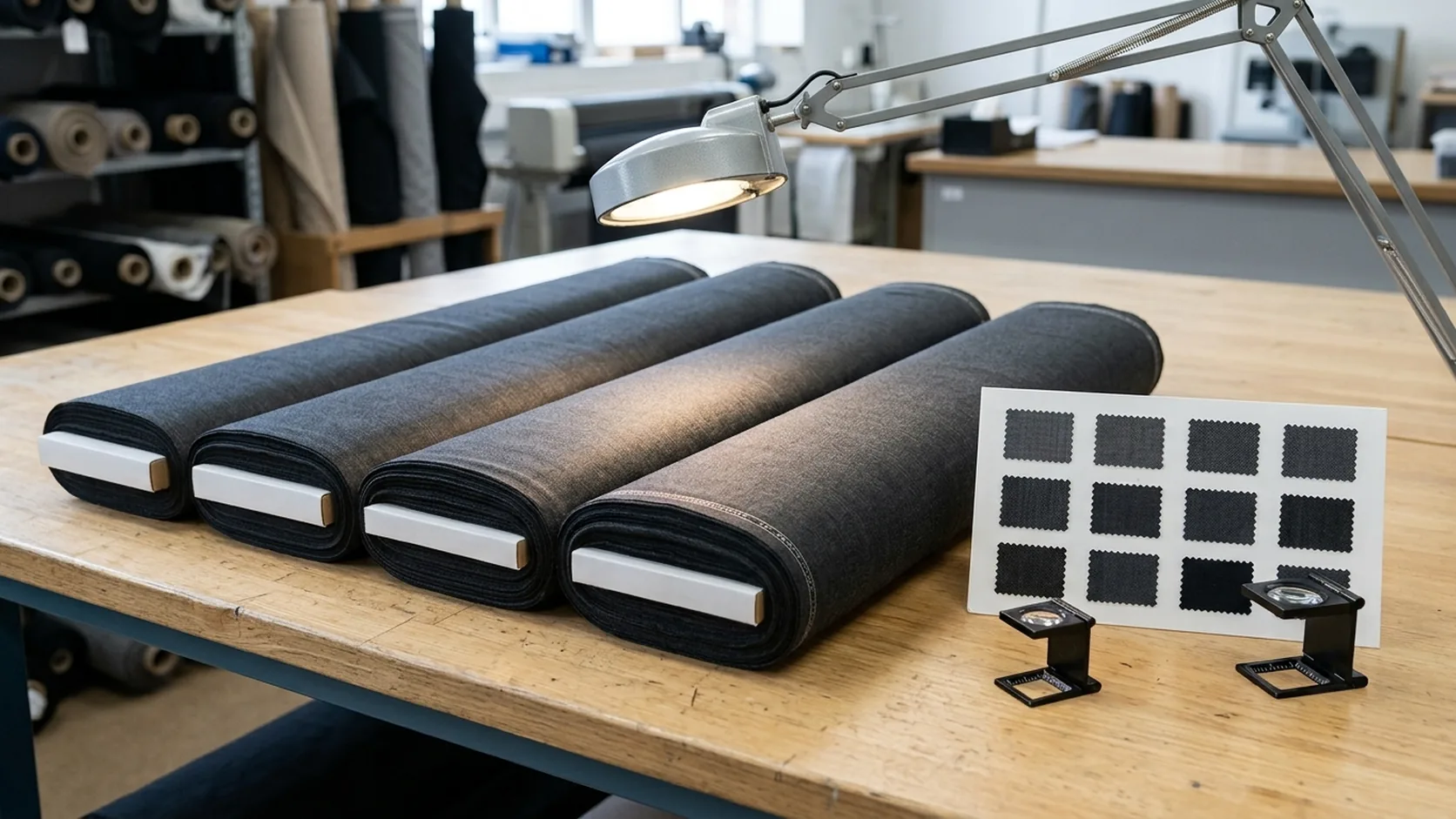
A buyer in Moscow, Dubai, or Milan cannot walk the inspection floor of a mill in Keqiao before a bulk order leaves China. You are buying against a swatch and a specification, trusting the roll that arrives matches both. That trust is earned through what actually gets checked before a lot is packed, not what's promised on a spec sheet. Here is what pre-shipment quality control covers, and why.
Colour fastness: why a bleeding lining is a real complaint
Colour fastness is how well a dye stays where it was put, under the stress a garment meets in use. It's usually assessed a few distinct ways:
- Rubbing (crocking) fastness, dry and wet: how much colour transfers when the fabric rubs against another surface. A dark jacket lining that leaves dye on a white shirt cuff after a humid day is a crocking failure, and one of the most common real-world complaints in tailoring.
- Wash fastness: how much colour fades or bleeds onto other fabric after repeated washing.
- Light fastness: how much colour fades after prolonged sunlight exposure, relevant for anything worn outdoors regularly.
Each is typically graded on a standard grey scale, from 1 (poor, heavy transfer or fading) to 5 (excellent, negligible change). A fabric with strong physical specifications but weak colour fastness still generates returns and disputes, because it fails exactly where a customer notices: a stained shirt, a faded jacket, a lining that looks worn after one season. This is a physical performance property of the dyed cloth, tested independently of what substances the dye itself contains.
The four-point system: how a roll gets graded for defects
Woven fabric is inspected against a widely used industry method generally known as four-point (4-point) inspection. An inspector examines the fabric on a lit table, and every defect found is scored by size and severity, from 1 point for a small flaw up to 4 points for one running the full width of the roll. Points are totalled and compared against an agreed threshold, expressed as points allowed per 100 square metres. A roll under the threshold passes; one over it is downgraded or rejected.
The defects being scored are mostly weaving and finishing faults:
| Defect | What it looks like |
|---|---|
| Skips | A missed interlacing, where the weft fails to catch a warp thread it should, leaving a small visible gap in the weave |
| Slubs | A thick, uneven lump in the yarn that shows up as a raised or irregular spot on the fabric face |
| Mispicks | A weft thread inserted at the wrong tension, doubled up, or missing, breaking the regularity of the weave |
| Oil stains | Marks left by machinery lubricant, usually running along the length of the roll where a loom part has made contact |
What matters for a buyer isn't memorising point values; it's knowing that a grading system exists, and asking which one a supplier uses and what threshold a lot must pass to count as first-quality export goods rather than downgraded or stock-lot fabric. A supplier who can't answer plainly is worth a second look.
Weight and width tolerance: the numbers behind your costing
Weight and width are two specification numbers a buyer orders against, and neither lands on the gram or centimetre in practice. As covered in our guide to fabric weight (GSM), a tolerance of roughly ±5% on weight is standard across woven suiting; agree it up front so a delivery a few grams under the ordered figure isn't a surprise. Width works the same way: a small variation between, say, 149 cm and 150 cm sounds minor, but it changes how many garment pieces you cut per metre, which moves a costing sheet once multiplied across a bulk order. Checking both against the agreed tolerance, on the actual rolls rather than the spec sheet, happens before every lot ships.
Shade and batch consistency across a lot
A single order is often produced across more than one dye batch, especially at larger quantities, and different batches of the same recipe can still land on a slightly different shade, a problem the trade calls dye-lot variation. It's rarely visible on one roll in isolation; it becomes obvious once rolls from different batches are cut into the same garment, or a buyer lays out a full shipment under one light. That is why inspection checks shade consistency across a lot's rolls, under consistent lighting, before they're packed together: catching an off-shade batch is far cheaper before shipping than after cutting.
What to ask for before you commit to a bulk order
A few concrete things are worth asking for before a large order is confirmed, regardless of who you source from:
- A pre-production sample or swatch approval. Confirm colour, hand, and weight against a physical reference before bulk dyeing or weaving begins, not after.
- Clarity on the grading system in use. Ask what defect-grading method and points-per-100-square-metres threshold a supplier applies, and what colour fastness ratings the fabric is tested to.
- A pre-shipment inspection report. For larger orders, it's reasonable to ask for a report on the actual lot, prepared by the supplier or an independent inspector of your choosing, before goods are loaded.
None of this replaces your own judgement, but asking upfront tends to tell you as much about a supplier as the answer does.
Not to be confused with Oeko-Tex Standard 100
Worth being precise here: the checks above are physical and visual performance checks, while Oeko-Tex Standard 100 explained covers something entirely different: whether the finished textile's components are free of harmful substances above regulated limits. A fabric can pass every physical check above and still need Oeko-Tex certification separately if your market requires it, and the reverse holds too; they're complementary checks on different questions, not substitutes for each other.
Key takeaways
- Colour fastness (crocking, wash, and light) is a physical performance property, tested separately from any chemical safety certification.
- The four-point system scores weaving defects like skips, slubs, mispicks, and oil stains by size, then grades a roll against a points-per-100-square-metres threshold; ask any supplier which system and threshold they use.
- Weight and width both carry a normal tolerance (around ±5% on weight); agree it up front, since both numbers feed directly into garment costing.
- A pre-production sample, a clear answer on grading systems, and a pre-shipment inspection report are all reasonable things to ask for before confirming a bulk order.
Want to see the fabric before you commit to a lot? Browse the catalog or send us your specification and we'll walk you through the checks that apply to it.