
Piece-dyed vs. yarn-dyed suiting: what's the difference
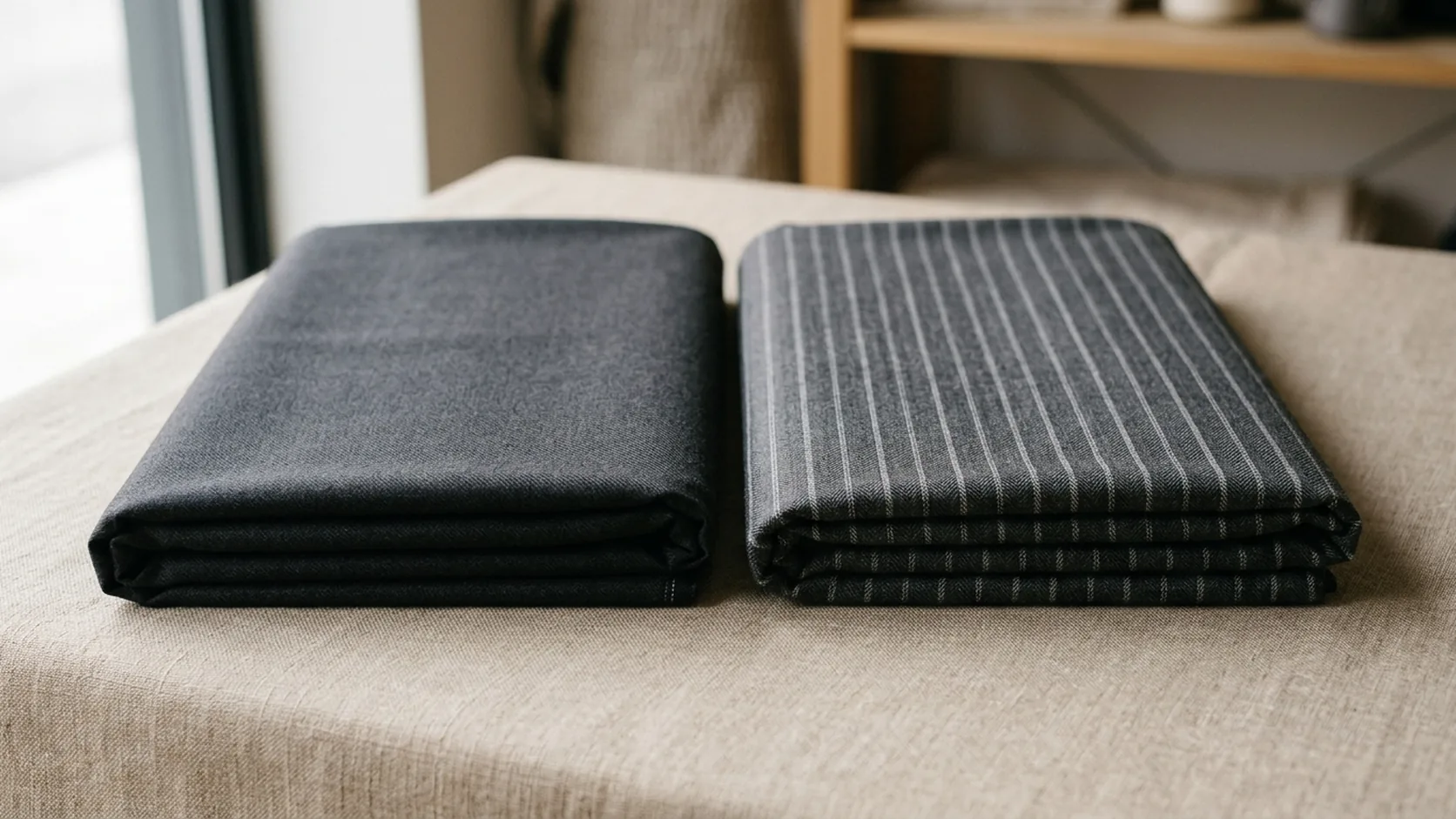
Every fabric in our catalog is filed under one of three categories, and two of them — piece-dyed and yarn-dyed — describe not what the cloth is made of, but when the color goes in. Get the distinction and you can predict, just from the swatch, whether a fabric can carry a pattern, how consistent the shade will run lot to lot, and which garment it's built for. Here is what each term actually means, how each is made, and how to choose between them.
Piece-dyed: the whole cloth is dyed after weaving
Piece-dyed fabric is woven first, from undyed (greige) yarn straight off the beam, and only afterward is the finished cloth — the whole "piece" — dyed as one continuous roll. The loom never sees color; the whole bolt goes into the dye bath together and comes out a single, uniform shade from selvedge to selvedge and end to end.
That's exactly the process our how suiting fabric is made guide describes for the poly-rayon blends we trade most: greige cloth off the loom, inspected, then dyed as a piece — disperse dye for the polyester component, a separate class for the rayon, to land on one even, solid color. Because the whole roll shares a single dye bath, piece-dyed fabric is the simplest route to a clean, solid shade, and it's how twills, gabardines, and other solid-color suiting cloths are made. Gabardine 1567 in our catalog, a 260 g/m² poly-rayon twill dyed as a finished piece, is a straightforward example.
Yarn-dyed: the pattern is built in before the loom starts
Yarn-dyed fabric reverses the sequence. The yarn itself is dyed first — spool by spool, or as skeins — before it ever reaches the loom. For the warp threads especially, the dyed yarn is then wound onto the beam in the exact stripe or check sequence the finished cloth needs; the pattern is set before a single pick of weft has been thrown.
That's the step our manufacturing guide calls out directly: the warp threads are dyed before weaving and arranged in the exact stripe sequence on the beam, so the pattern is literally built into the warp. It's the only way to produce pinstripes, multi-stripes, checks, and the subtler micro-patterns and tonal weaves that make up nearly all patterned business suiting — the pattern lives in the weave structure itself, not printed onto the surface afterward. Pinstripe 3012 and Micro pattern 3108 in our catalog are both yarn-dyed for exactly this reason.
The practical tradeoffs
- Pattern capability. Piece-dyed can only ever be solid; there is no way to put a stripe or check into cloth that's dyed as a finished piece. Yarn-dyed is the only route to a pattern that's woven in rather than printed on.
- Shade consistency. Piece-dyed fabric usually runs more consistent from lot to lot, since an entire roll shares one dye bath and one set of process conditions. Yarn-dyed fabric depends on matching dye lots across many separate yarn spools before weaving even starts, so a slightly wider batch-to-batch shade variation is normal and expected, not a defect — it's a function of the process, not a quality shortfall.
- End use. Piece-dyed is the default for trousers, uniforms, and linings, where buyers want a clean, uniform shade and a crease that presses sharp and stays put. Yarn-dyed is the default for jackets and suits meant to read as tailored, where the pattern is the point.
- Weight and hand still matter separately. Dyeing method doesn't replace the other specifications on an order — see our fabric weight (GSM) guide for how weight interacts with composition and finishing regardless of which dyeing method is used.
Cost and lead time: standard, not a premium
Yarn-dyeing is genuinely a more involved upstream step: dyeing hundreds of individual cones, matching them into consistent lots, then warping and beaming them in an exact stripe sequence takes more handling and more planning than piece-dyeing a finished roll. In many markets that extra labor shows up as a price premium.
In Keqiao it mostly doesn't. Yarn-dyeing is routine, high-volume infrastructure here, not a specialty run reserved for small orders, so yarn-dyed and piece-dyed suiting at a comparable weight and composition are usually priced in the same band, with similar MOQs (300–500m) and lead times. Budget by weight, composition, and quantity as you normally would; don't expect a pattern surcharge just because the yarn was dyed before weaving rather than after.
Piece-dyed vs. yarn-dyed at a glance
| Aspect | Piece-dyed | Yarn-dyed |
|---|---|---|
| Pattern capability | Solid colors only | Stripes, checks, pinstripes, micro-patterns |
| Typical shade consistency | Generally most consistent lot to lot | Slightly more batch variation; depends on yarn dye-lot matching |
| Typical end use | Trousers, uniforms, linings needing a clean, uniform shade | Business jackets and suits where a woven-in pattern is wanted |
| Example from the catalog | Gabardine 1567 (260 g/m², piece-dyed) | Pinstripe 3012 (240 g/m², yarn-dyed) |
Key takeaways
- Piece-dyed fabric is woven from undyed yarn, then the whole finished cloth is dyed as one piece for a solid, uniform shade.
- Yarn-dyed fabric is dyed before weaving, which is how stripes, checks, pinstripes, and micro-patterns are woven into the cloth rather than printed on.
- Piece-dyed usually runs more shade-consistent lot to lot; yarn-dyed carries slightly more batch variation because it depends on matching dye lots across yarn spools.
- Yarn-dyeing is a more involved upstream step, but it's standard infrastructure in Keqiao, not a cost premium.
Know which one you need? Browse the catalog — filter by piece-dyed or yarn-dyed to see composition, weight, and width for each — or send your specification and we'll quote within one business day.