
Poly-rayon vs. wool suiting: choosing the right composition
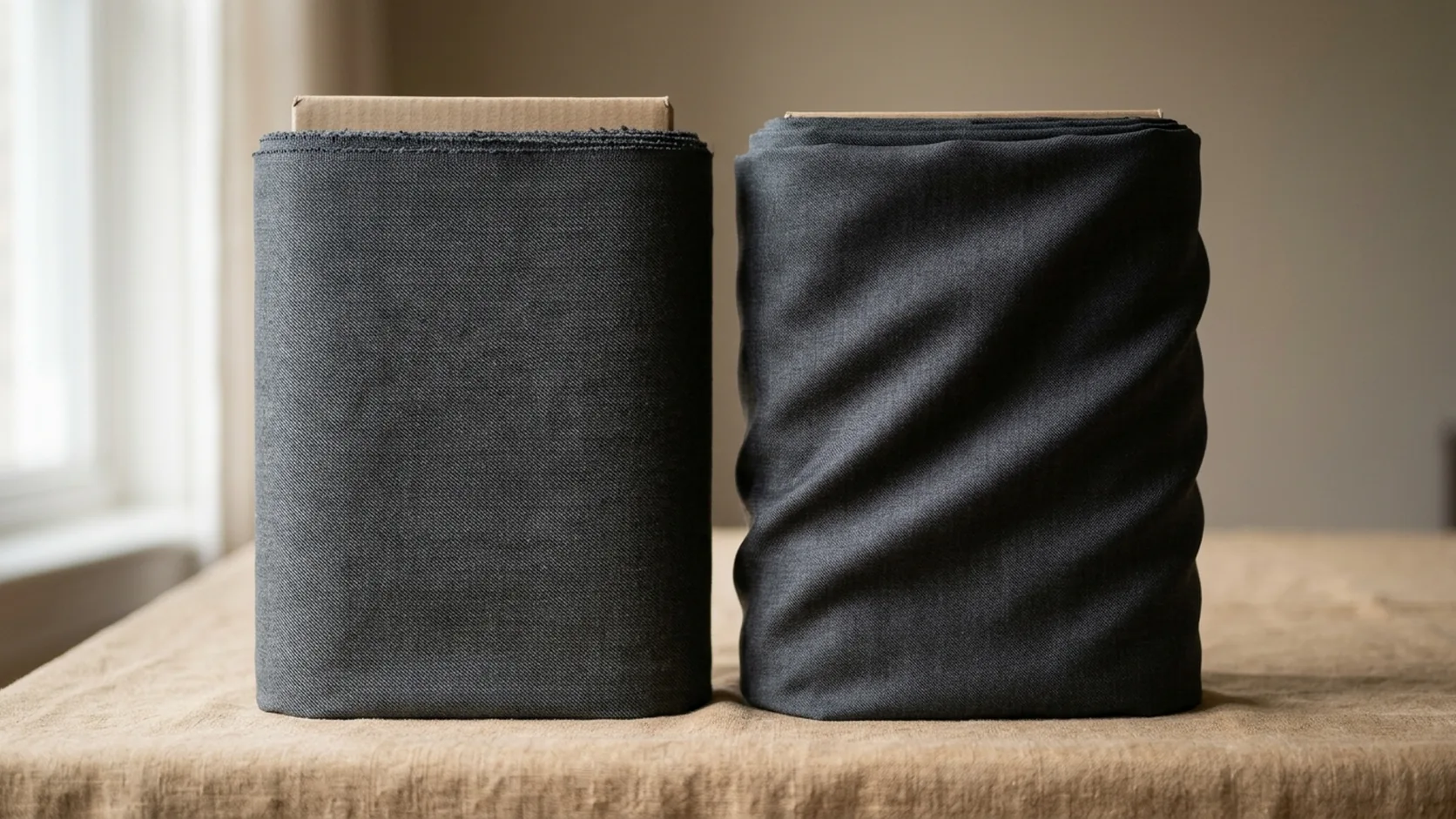
Composition is the first filter most buyers click, before weight or colour, and it deserves to be. It splits the catalog into two fabrics built for two different jobs: a poly-rayon blend engineered to behave like a wool worsted at a fraction of the price, and a worsted wool cloth that costs more because there is no shortcut to what it does. Here is what actually separates them, and how to decide which one belongs in your next order.
What each composition actually is
Most of the suiting we trade is a blended spun yarn, typically 65% polyester and 35% rayon (viscose), with a handful of articles running 60/40 or 70/30 depending on the hand the mill is aiming for. It's woven and finished into 230–260 g/m² cloth at 150 cm width, and it's engineered from the yarn up to imitate a wool-blend worsted at a lower cost. The two fibres do different jobs: polyester supplies strength, crease recovery, and dimensional stability, while rayon supplies softness, drape, and a matte, wool-like surface instead of a synthetic sheen. (We cover how that yarn is spun and woven in how suiting fabric is made.)
Our wool line is a single article, a worsted suiting at 260 g/m² and 150 cm width, made from combed wool tops rather than a blended staple fibre. That distinction is a large part of why it costs more: combing removes short fibres and aligns the long ones before spinning, producing a finer, more even yarn than a blended staple can match. The result is a cloth with natural breathability, a favourable warmth-to-weight ratio, and a noticeably smoother, more refined hand, with genuinely superior drape and crease recovery at rest. A wool jacket hung overnight will often shed its wrinkles on its own. The trade-off is that it rewards more careful pressing and handling than a synthetic blend will forgive.
The trade-offs buyers actually weigh
Composition is rarely a simple "better or worse" choice; it's a set of trade-offs that should track your price point, climate, and end use.
- Cost tier. Wool suiting runs several multiples the price of poly-rayon at an equivalent weight, driven by raw fibre cost and the extra combing step. It's a large part of why wool sits at the premium end of the range rather than the volume end.
- Hand and appearance. Poly-rayon has a crisp, slightly drier hand with a soft matte surface; worsted wool feels noticeably smoother and more refined, with a subtler, richer surface that reads as premium tailoring rather than value suiting.
- Breathability and climate. Poly-rayon's durability and lower cost make it a natural fit for high-volume value suiting, uniforms, and warmer climates and long working days. Wool's breathability and warmth-to-weight ratio suit cooler markets and premium tailoring where comfort at temperature, not just cost, matters.
- Durability and pilling. The polyester content in poly-rayon resists pilling and abrasion well and stands up to repeated wear. Worsted wool is naturally resilient at rest but, being a finer, more open yarn, can pill under sustained friction and rewards gentler handling.
- Care and maintenance. Poly-rayon tolerates everyday steam pressing and is generally more forgiving in transit and use. Wool suiting is best dry-cleaned and pressed with more care, to protect the surface and the crease it holds so well.
- Availability. Poly-rayon is mostly held in-stock, so it ships fast against most orders. Wool is made-to-order only: because it isn't a fabric we hold in inventory, expect a longer lead time, and plan your order calendar accordingly.
Composition at a glance
| Composition | Typical weight | Hand & drape | Climate fit | Availability | Relative cost |
|---|---|---|---|---|---|
| Poly-rayon (65/35, also 60/40, 70/30) | 230–260 g/m² | Crisp, slightly dry hand; matte, wool-like surface; good drape without excess softness | Warm-to-temperate climates; high-volume value suiting and uniforms | Mostly in-stock; fast fulfilment | Entry-to-mid tier |
| Worsted wool (100% wool) | 260 g/m² | Smoother, more refined hand; superior drape; strong crease recovery at rest | Cooler markets; premium tailoring | Made-to-order only; longer lead time | Several multiples higher |
Which one to specify
Start from the garment and the market, not the fibre. If you're sourcing high-volume business suiting or uniforms for a warmer climate, or the order needs to ship fast against stock, poly-rayon at 230–260 g/m² is almost always the right call. See our guide to fabric weight (GSM) for picking the exact weight inside that range. If the end customer is buying premium tailoring for a cooler market and values hand-feel and drape over price, worsted wool is worth the extra cost and the wait, provided your production schedule has room for a made-to-order lead time rather than an immediate ship date.
Whichever you choose, specify composition alongside weight, width, and end use in the same request; that combination is what lets us match a real article rather than guess at one.
Key takeaways
- Poly-rayon (mostly 65% polyester / 35% rayon) is engineered to behave like a wool worsted: polyester for strength and crease recovery, rayon for softness, drape, and a matte surface.
- Our wool is a single worsted article made from combed wool tops, giving it a smoother hand, better breathability, and superior drape and crease recovery, at several multiples the cost.
- Poly-rayon suits high-volume, warmer-climate, value suiting and uniforms; wool suits premium tailoring in cooler markets.
- Poly-rayon is mostly in-stock and ships fast; wool is made-to-order only, so plan for a longer lead time.
Know which composition your order needs? Filter the catalog by composition to see what's in stock, or send your specification and we'll quote within one business day.